
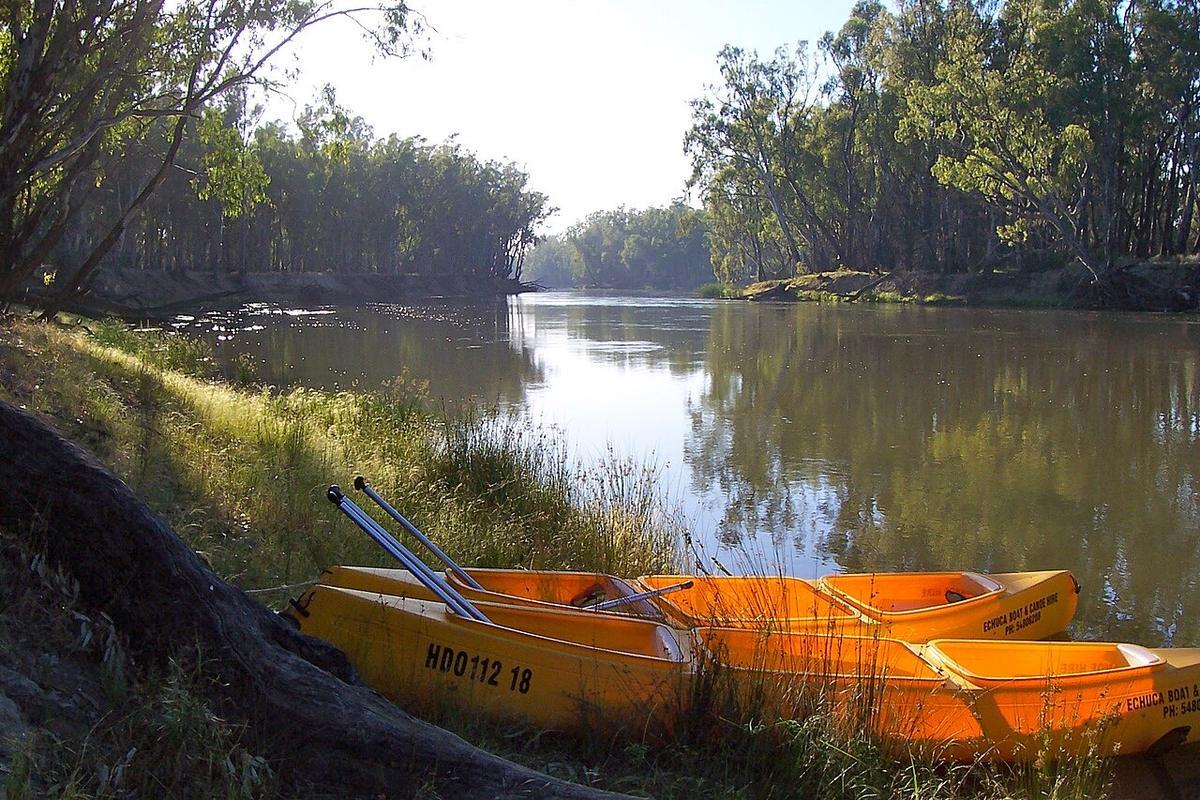
The Murray is Australia's longest river. It leaves the Snowy Mountains and runs more than 2,000 km across mostly flat country to the Southern Ocean. The middle and lower reaches are wide, slow and warm in summer. Red gums line the banks for long stretches. A sandbar forms on the inside of every bend. The river moves, but it never hurries you. Big-sky days, simple camps, easy logistics. Come for that and it delivers, reliably.
Picking a reach
Paddling the Murray means choosing which few days of a very long river you want. The character shifts a long way between the upper reaches near the mountains and the heavily regulated lower river approaching the lakes. The broad middle sections that form the New South Wales and Victoria border are the most paddled. Forested banks, and reasonable access at dozens of towns.
Red gum forest reaches give you the wildest days. Long gaps between roads, birds overhead and the sound of the river. Town reaches keep road access close, with easier resupply and simple car logistics. Neither is wrong. Pick by how long you have, how self-sufficient you want to be, and where you can leave a car.
Study the map before you decide. Parks and land managers on both sides of the border look after the Murray. Check the relevant parks services for Victoria and New South Wales, along with the Murray-Darling Basin Authority, before you settle on a section.
The sandbar camp
The classic Murray night is a swag or tent on a sandbar. Red gums overhead, a fire if conditions allow, and a river flat enough to hold your reflection. Sandbars form reliably on the inside of bends, and they are the reason people come back to this river year after year.
Sandbar camping looks simple. It needs a little thought. The Murray is a regulated river, and releases from upstream storages move water levels independently of any rain you can see. A sandbar well above water at sunset can look different by morning. Camp higher than you think you need to. Before you leave, check what level changes are expected on your section during your trip.
Camping rules vary by reach and by which state the bank sits in. Some stretches have designated camps. Others carry restrictions. Contact the relevant parks service before you go and confirm what is allowed on the section you are planning.
Current and river traffic
The Murray moves steadily. Nothing dramatic, but the current is real and it carries you downstream without much effort. Over a full day on the water the drift adds up.
The river also carries houseboats, ski boats and fishing vessels, especially on the more accessible middle reaches. The houseboat lanes follow the deep water in the centre of the channel. Ski boats use the same space at speed. A packraft or small inflatable sits low on the water, and from the helm of a boat moving fast it is not easy to see.
Paddle the edges, not the middle. Make yourself visible. Wear colour. When you need to cross, pick your moment and cross with purpose, not gradually. Look behind you before you move.
Snags are everywhere. River red gums have been falling into this river for thousands of years, and the submerged logs do not move. They gather on the outside of bends where the current scours the bank. Stay aware of what is under the surface, particularly after dark.
Heat planning
Inland summer heat is a serious consideration on the Murray. Temperatures above 40 degrees are possible through January and February, and the wide flat valley offers little shade away from the trees. Start at dawn. Spend the middle of the day in shade and rest. Get back on the water in the late afternoon.
Carry more water than you think you need. The river is not reliably safe to drink without treatment, and access to town water depends on how far you are from a boat ramp. Bring a filter or another purification method. Regular stops to swim or wade keep your body temperature in check. Use the river for that. It is wide, warm and right there.
The drift-and-walk trick
The Murray flows one way and most people need their car at the end. A full shuttle takes two vehicles or a willing driver. On some sections there is a simpler answer. Drift downstream for a few hours, pull out, and walk back along the river tracks to where you started.
The river does the downstream work. You do the return on foot. A packraft weighs a few kilograms and rolls into a daypack. The plan depends on a usable track along the bank. Some reaches have well-established forest paths. Others are thicker. Check before you commit. On the right section a short loop needs no car shuffle at all.
Who it suits
The Murray suits paddlers who want days that run at the river's pace. On most sections it will not test your technical skills. What it asks for is patience, plus some planning around heat, water, camping and river traffic.
It suits people who want to sleep out in good country without complicated logistics. The red gum forests along the long middle reaches impress in a quiet way. The Murray is not the river for whitewater or exposed coast. It is flat water with current, regulated and busy in places, and that is exactly what makes it right for an unhurried overnight with simple gear.
Slow, regulated water with sandy camps and room to drift is well within a Seeka's range.