
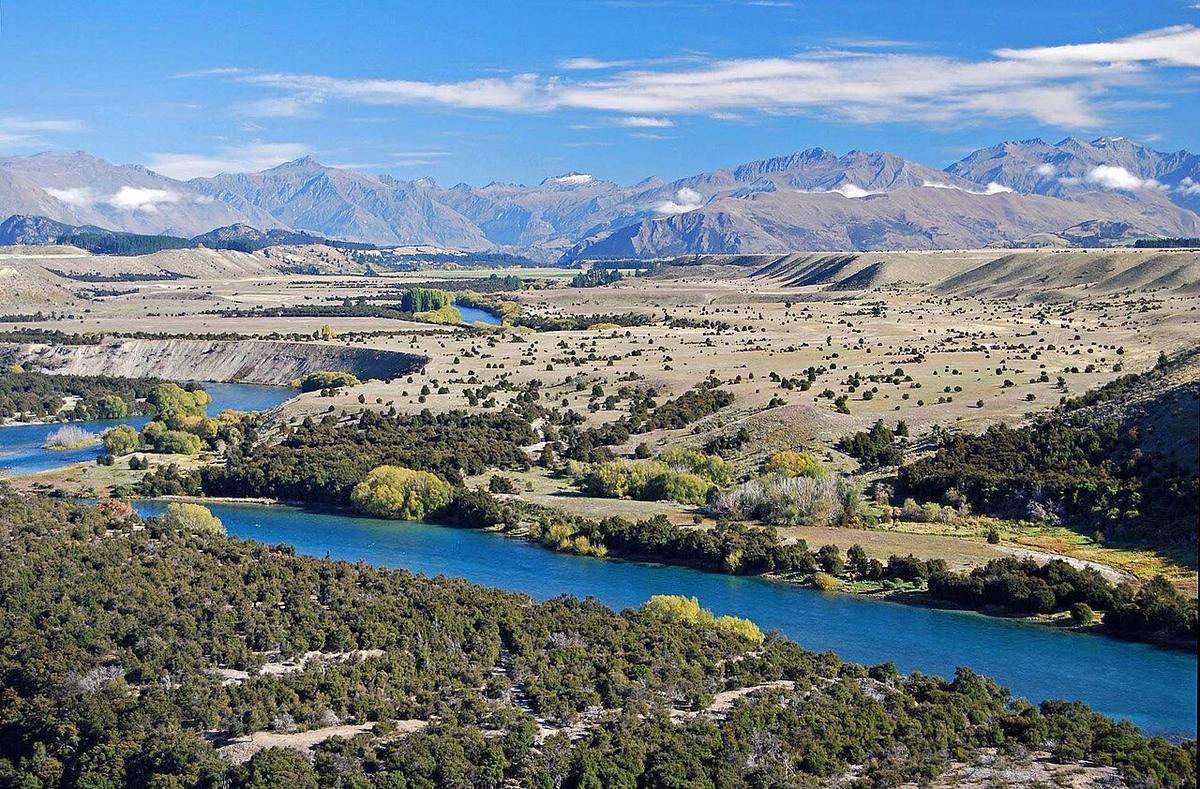
The Clutha Mata-Au is New Zealand's highest-volume river and the country's second longest. It drains Lake Wanaka in Central Otago and runs south through the high country to the coast below Balclutha, covering hundreds of kilometres on its way to the Pacific. The water is glacier-blue, cold every month of the year, and moves fast almost everywhere. From a bridge or a hillside it looks serene. From a hull on the surface it is something else entirely.
The river in numbers and character
Volume defines the Clutha Mata-Au. A high-volume river is not simply a big river. It is a river where the mass of water in motion generates forces that do not exist on smaller streams. The current is powerful across its full width. Eddies form and collapse. Boils push up from the riverbed without warning. The surface can look smooth and calm in the same breath that it pulls a paddler downstream faster than they can sprint.
The water comes from the Southern Alps and carries the cold of snowmelt year-round. This river has no warm season. Mid-summer air temperatures in Central Otago can be high, but the water does not follow them. Towns along the river include Wanaka and Albert Town near the upper reaches, then Cromwell, Clyde and Alexandra further south. The Clyde and Roxburgh hydro dams sit on the main stem, each holding a significant lake behind it.
What volume means for a paddler
Smooth is not gentle. That is the single most important thing to understand about the Clutha Mata-Au. The water looks glassy in photographs and on calm mornings. It moves like a train. A paddler who comes off their craft here is carried downstream quickly, covering ground faster than bank-based rescuers can follow. Swims on a river of this volume are long and cold.
Eddy lines on a big-volume river are not the minor boundaries you meet on smaller streams. They are the edges between bodies of water moving in different directions at speed. Crossing one in a small inflatable takes technique and attention. Boils push up from depth and can destabilise a craft without warning, even in reaches that look completely flat. None of this is hypothetical. It is the ordinary physics of a river this size.
Cold water is a separate and serious issue. Snowmelt-fed rivers do not warm the way lowland rivers do. Immersion in cold water causes rapid heat loss and can incapacitate a paddler before they reach the bank. Immersion protection is not optional on the Clutha Mata-Au, and it is not seasonal. A wetsuit at minimum. A drysuit for any extended time on the river.
The sections and what they offer
The upper river near Wanaka and Albert Town is popular moving water and draws experienced paddlers and commercial operations. The character here is fast and open. Downstream, the hydro lakes behind Clyde Dam and Roxburgh Dam offer stiller, wider water with the feel of a large reservoir rather than a river. They are distinct environments from the river proper.
The dams themselves are absolute no-go zones. Water released through hydro infrastructure creates conditions that are fatal to paddlers in the vicinity. There are no exceptions. Each dam has exclusion zones that must be respected without question.
Section character changes with water level, season and recent weather. What is manageable at one flow can be significantly more demanding at another. Before choosing any reach of the Clutha Mata-Au, check current flow data and talk to local paddlers and operators who know the river at the time you intend to paddle it. General descriptions, this one included, are no substitute for current local knowledge.
Cold every month
The Clutha Mata-Au is fed by the Southern Alps, and Lake Wanaka sits at altitude. The river does not warm meaningfully in summer. Water temperature stays cold through the year, and in winter it drops further. Central Otago summers are hot and dry by New Zealand standards, with temperatures that make the river look inviting. That contrast is part of what makes cold-water immersion here dangerous. Conditions on the bank do not prepare you for conditions in the water.
Plan for cold water regardless of the air temperature and regardless of the season. If you go in, your time to act before cold affects your coordination is short. Tell someone your plans before you put in. Carry a means of signalling for help that works when wet.
Who the river suits
The river proper is for experienced moving-water paddlers with a clear understanding of big-volume conditions. It is not a river for people new to moving water, and experience on smaller rivers does not translate directly. Volume changes what the water does. Paddlers who understand that and have the skills to manage it can find rewarding water here. Paddlers who are uncertain belong elsewhere until they have built the relevant experience.
Flat-water paddlers belong on the hydro lakes behind Clyde and Roxburgh dams, or on Lake Wanaka itself. These are large bodies of water with their own rewards and their own conditions to manage. They are not second-best alternatives. They are different trips.
Calmer water in the same country
Lake Wanaka and Lake Hawea offer long, open shorelines for paddlers who want calm water with mountain scenery and no river current to manage. On a settled morning these lakes are at their best. Wind builds across a large lake surface quickly, so start early and hug the shore. The hydro lakes behind Clyde and Roxburgh dams are calmer than the river and reachable from the same towns. None of them ask for the big-volume skills the river demands.
The Clutha proper is beyond what a Seeka is built for. The lakes it feeds and fills are another story.